BOTM 002 | Engineering Vulnerability
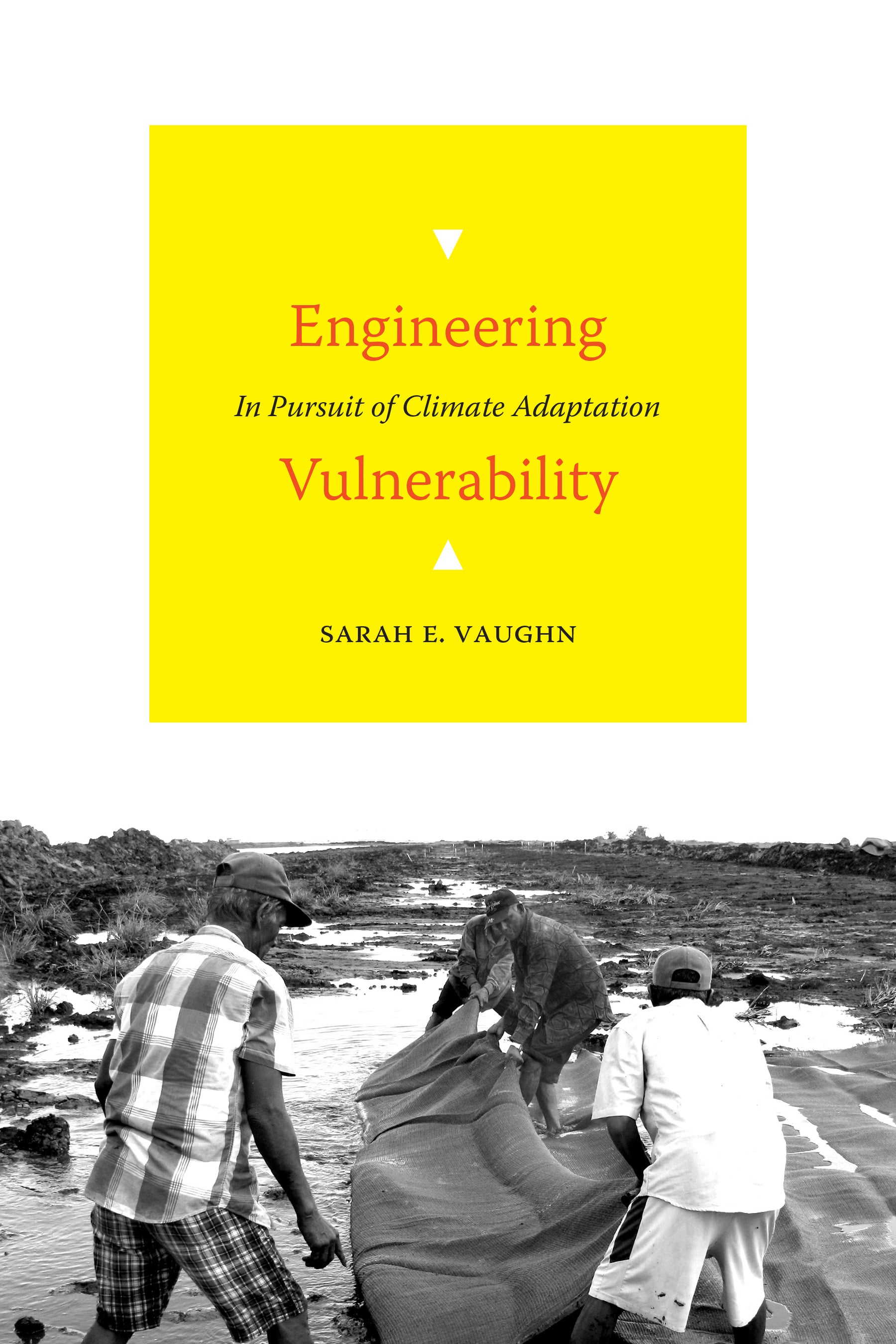
Cover art: Laborers folding geotextiles. Construction site of the Hope Canal in Guyana, 2014. Courtesy of the author.
Title: Engineering Vulnerability: In Pursuit of Climate Adaptation
Published: Durham and London 2020 by Duke University Press
Author: Sarah E. Vaughn
Editor: N/A
Description: Sarah E. Vaughn’s Engineering Vulnerability is a case study of climate adaptation in Guyana after the catastrophic flood of 2005. This flood in particular was devastating not only because of the overtopping of East Demerara Water Conservancy (EDWC) but record breaking rainfall. Vaughn not only explores the infrastructural projects and the engineering behind them, but seeks to expose how race, (in)equality, and vulnerability are all intertwined with climate change. “Approaching climate adaption this way, Vaughn exposes the generative openings as well as gaps in racial thinking for theorizing climate action, environmental justice, and, more broadly, future life on a warming planet.”
(Engineering Vulnerability, Back Cover)
Themes of Engineering Vulnerability
Overall
In Vaughn’s words, “Climate adaptation and its connections to settlement provide this book’s unifying theme. I [Vaughn] draws on ethnography, oral histories, colonial records, photographs, and engineering reports to make these connections visible.” (Engineering Vulnerability, 2) Vaughn aims to show how “climate adaptation's importance lies not only in its technological feats but also in constituting political imaginations.” (Engineering Vulnerability, 2) The book begins with the flood of 2005 and then goes forward and b ackwards in time to both lead up to the flood and see where Guyana has come since. Some of the topics and themes discussed in the book include the EDWC, Guyana’s Low Carbon Development Strategy (LCDS), climate change, oil, as well as social vulnerability and identity politics.
East Demerara Water Conservancy (EDWC)
The EDWC is a large freshwater storage reservoir that is essential to Guyana flood mitigation strategy and water supply. In 2005 a weakened EDWC failed at managing the record rainfall of 2005 leading to flooding when sections of the EDWC experienced overtopping where water rushed over its embankments. With Guyana being six-feet below sea level and the EDWC being on higher ground located inland this condition essentially created a bowl along the coast trapping Guyanese in some of the worst flooding conditions the country has seen. While a critical piece of infrastructure, "Many think about the EDWC only when they have flash-backs about the 2005 disaster, see too much water in their yards, or hear meteorologists warn of a rain-drenched forecast." (Engineering Vulnerability, 11) Further more, "When things started to go bad financially, we still had the infrastructure, which was good, but we did not have the money to maintain the infrastructures." (Engineering Vulnerability, 92) While in need of repair the EDWC is a critical piece of infrastructure that without, would have led to even more catastrophic flooding. While in need of repair, many talented Guyanese engineers improvise with materials they have as best they can. “…So we had to innovate. We did river defense using timber sheet piling. There's no way anybody was gonna do that, then or now. So let's say there is a breach, and you can just get timber sheet piling to build a wall, but you should have used steel. But that's what we could afford. So that's what we did." (Engineering Vulnerability, 93)
Low Carbon Development Strategy (LCDS)
“In 2009, President Bharrat Jagdeo held a press conference in Guyana with a handful of foreign dignitaries to release the Low Carbon Development Strategy (LCDS), a report detailing the country’s plans for climate adaptation. Ambitious in scope, LCDS looks to the country's forests as a resource for carbon trading schemes with Norway. The funds raised from these schemes are intended to partially sponsor the long-term adaptation of, among other things, irrigation and drainage infrastructure." (Engineering Vulnerability, 8) Information can be found on the Government of Guyana’s public website for the strategy here. However in short it is an extremely comprehensive and robust plan for how Guyana will adapt for the climate spanning everything from funding mechanism to renewable energy generation and ecotourism.
Engineering, Archives, and Experts
One interesting aspect this book reveals about infrastructure in Guyana is a problem faced by many disciplines was a lack of data. "'[There are] no soil investigations or recent data available to support detailed assessment of the EDWC' The EDWC's care, in other words, is dependent on an archive of documents that describe soils and rainfall, among other things. In the broadest sense, engineers' professional ethics of archiving is built on the expectation that the state will provide resources, technologies, and equipment that will aid their data collection." (Engineering Vulnerability, 69-70) This lack of data makes it difficult for engineers to predict into the future and model present day conditions and in that proves the value of archives and good data. "Engineering reports undergird and give meaning to engineers' professional sense of authority. But as the case of EDWC also reveals, engineering reports do not exist only for engineers to design. They also exist to be preserved for other engineers to reference. Thus the transformation of engineering reports into archives is a fundamental activity for the reproduction of knowledge exchange and sense of fraternity within the profession." (Engineering Vulnerability, 94)
Table of Contents:
Introduction - “Where Would I Go? There Was No Place With No Water”
1 | Disaster Evidence
2 | The Racial Politics of Settlers
3 | Engineering, Archives, and Experts
4 | Compensation and Resettlement
5 | Love Stories
6 | Accountability and the Militarization of Technoscience
7 | The Ordinary
Conclusion - Materializing Race and Climate Change