BOTM 004 | Blood on the River
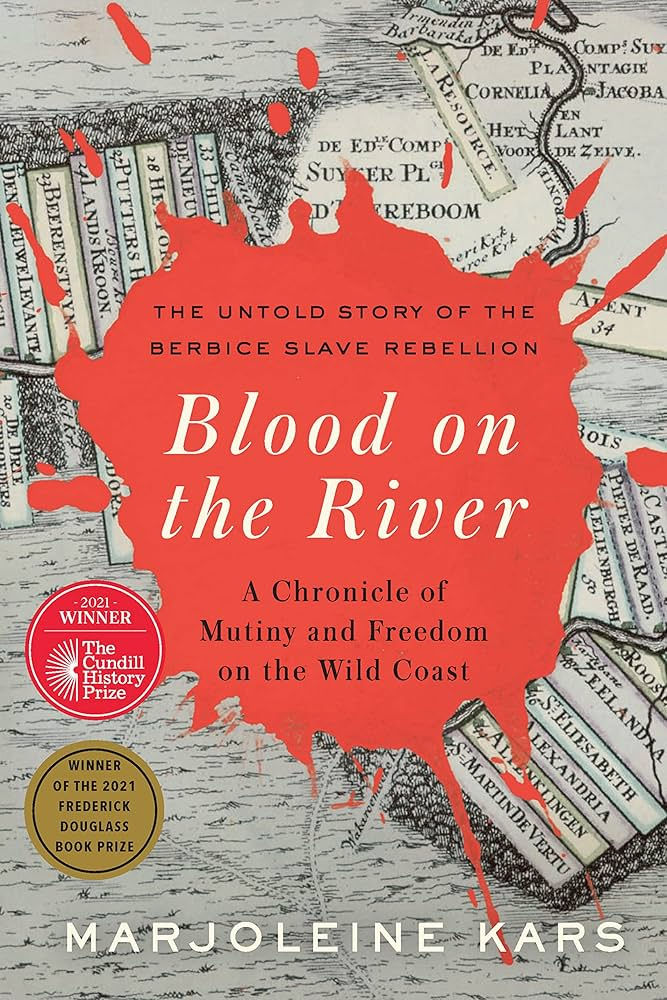
Jacket image: map of the Berbice River and plantations in the chartered colony of Berbice by Jan Daniel Knapp (1742), Rijksmuseum, Amsterdam. Jacket design by Emily Mahon.
Title: Blood on the River: A Chronicle of Mutiny and Freedom on the Wild Coast
Published: New York 2020 by The New Press
Author: Marjoleine Kars
Editor: N/A
Description: “On Sunday, February 27th, 1763, thousands of slaves in the Dutch colony of Berbice-in present-day Guyana-launched a massive rebellion that came amazingly close to succeeding. Surrounded by jungle and savannah, the revolutionaries (many of them African-born) and Europeans struck and parried for an entire year… Blood on the River is the explosive story of this little-known revolution, one that almost changed the face of the Americas…. Drawing on nine hundred interrogation transcripts collected by the Dutch when the Berbice rebellion finally collapsed, and which were subsequently buried in Dutch archives, Historian Marjoleine Kars reconstructs an extraordinarily rich day-by-day account of this pivotal event. Blood on the River provides a rare in-depth look at the political vision of enslaved people at the dawn of the Age of Revolution… Blood on the River will change our understanding of revolutions, slavery, and the story of freedom in the New World.”
(Blood on the River, Inside Cover)
Blood on the River and the Almost-Revolution on 1763 in Berbice
Overall
Marjoleine Kars’s Blood on the River begins with the kind of archival discovery that feels almost impossible: "A few years before, in the Dutch National Archives in the Hague, I happened upon a cache of records about a massive slave rebellion." (Blood on the River, 1) From that discovery emerges one of the most extraordinary histories in the Caribbean and South America. As Kars writes, "Despite the eventual failure of the Berbice Rebellion, nowhere else, with the exception of Haiti, did self-liberated people control an entire colony for so long, or come so close to winning." (Blood on the River, 9) For Guyanese history, that statement is staggering. Berbice was not a minor disturbance at the edge of an empire. It was one of the closest calls slavery ever faced in the Americas.
What makes the rebellion so powerful is not only its scale, but how vividly the world around it still lingers in memory and landscape. "People pointed out the tall silk cotton trees under which the Dutch allegedly buried their silver at the start of the revolt. The height of the trees made it impossible to forget where these valuables had been hidden. The Dutch bewitched these trees to keep their coins safe from their slaves. Wherever you see such a tree rising above the bush, people say, there would have been a Dutch plantation. Many Afro-Guyanese still consider these trees cursed." (Blood on the River, 6-7) She also describes "The so-called talking tree, an enormous tree some twenty-five feet around at its base, can be reached only by hacking the under growth with a machete. Rebels used this tree, so the story goes, to bang out messages to allies on the nearby Canje River. The sound made by hitting the roots of this tree can be heard for miles." (Blood on the River, 7)
The Uprising
The uprising itself began with an act of refusal. "That Monday, most of them failed to report for work. Instead, they slaughtered and barbecued several cows, raided the plantation house, and loaded three large canoes with clothes, food, and drink. As Kunkler was a captain of the colony's militia, he stored weapons on his plantation. The rebels took control of this cache of thirteen guns and powder. Defiantly flying the militia flag, twenty-six adults and children, including fifteen able-bodied men, pointed their canoes upriver. They called on their gods by singing and beating their drums. They urged the people on the neighboring plantation, Boschlust, to join them, but they declined, just as eight months later they would refuse to join the big rebellion." (Blood on the River, 16)
Part of what made that possible was just how weak Berbice really was. "The military in Berbice was virtually nonexistent. Europeans in Berbice made up less than 5 percent of the population, holding sway with guns and brutal violence. But unlike Caribbean colonies such as Barbados and Jamaica, which also had huge African majorities, Berbice was tiny, with a poorly developed government and military structure. Due to high costs, the Company sent few Dutch soldiers, and most sickened immediately in the tropical climate with its frequent epidemics." (Blood on the River, 17-18) Europeans were a tiny minority, the colony was poorly governed, and the Dutch West India Company had long run Berbice on neglect.
But even with this weakness we may have seen the downfall of this rebellion foreshadowed by some of the telling actions of other enslaved people during that first Monday of the rebellion in the lines: “They urged the people on the neighboring plantation, Boschlust, to join them, but they declined, just as eight months later they would refuse to join the big rebellion." (Blood on the River, 16) Throughout the rebellion which lasted over a year it was a story of a bloody back and forth of fighting, negotiations, and struggle. At one point during negotiations to divide the territory leader Coffij was sentenced to death. "Instead, Coffij was sentenced to be tied 'to a cross, to be broken alive from his feet up,' his body and severed head displayed underneath the gallows 'until the birds and air have consumed it.' This was considered a more lenient sentence since hanging by a hook could take days to bring death." (Blood on the River, 22) During these negotiations "He [Coffij] was asked whether he regretted his actions. His reply carried an ominous foreboding. What the slaves had failed to accomplish, he reportedly predicted, 'others would soon carry out.'" (Blood on the River, 22) This sentence as part of negotiations was never carried out as the attempt to form a treaty failed. Ultimately however, Coffij’s belief in further negotiations is what led to his death.
Further into the rebellion skepticism of Coffij’s negotiations began to emerge. "Rather, Atta claimed, he and Coffij disagreed about the Ganga, 'whom Coffij wanted to kill and he [Atta] wanted to retain.' As a result of the conflict, which signaled a profound lack of confidence in his leadership, Coffij shot himself, though the date remains unclear. The coup likely happened in September, after Coffij reopened, and then ended, the second round of negotiations in August. The Dutch learned in mid-October that Governor Coffij had killed himself, that Captain Accara had been enslaved, and that Atta was the new 'chieftain.' Coffij, the leader of the largest slave rebellion in the Caribbean to date, a man who had dared to dream of a new colonial order, who, had succeeded, might well have governed the first black republic, slipped out of history with barely a notice." (Blood on the River, 167) While may seem like an unlikely turn in this story it may be less surprising as one thinks. "Among the Yoruba people in precolonial Oyo, for instance, which covered parts of what are now Nigeria and Benin in West Africa, kings who lost support of the council of chiefs were expected to kill themselves to avoid public shame, earn respect, and prevent further violence. Governor Coffij's suicide should be seen in a similar vein." (Blood on the River, 168) This tragic moment unfortunately came at the worst time as the Dutch were at the brink of collapse.
"Perpetually short on money and more inclined to pay themselves and their shareholders than invest in infrastructure, defense, or 'officials' salaries, the Company's directors ran the colony on a miserly budget. Incompetent governors and the directors' own blundering administration from afar did little to foster community among planters who hailed from many European nations, felt little loyalty to the Company or the colony, and narrowly focused on short-term profits. One of the few historians to study the Company's records in any detail judged that 'no colony was less ably governed than Berbice,' at least until the appointment of Governor Wolphert Simon van Hoogenheim in 1760." (Blood on the River, 51) This sate led Dutch Governor Van Hoogenheim to write "'We are here at the brink… invoking a quintessential Dutch metaphor about drowning, 'the water has been brought to our lips.'" (Blood on the River, 173) What a strange irony that those who led to so many slaves drowning felt their own sense of impending doom. Unfortunately when the Dutch got the news of Coffij’s suicide and a fresh arrival ship of soilders and supplies had just come to port and enabled them to end the rebellion.
Colonists Hidden ‘Edge‘
And so the question lingers: "How on earth, one wonders, had the outnumbered, ill-supplied, and ill adapted Dutch managed to rule their Colony of Berbice for 150 years? How had this tenuous enterprise come about? How had it lasted?" (Blood on the River, 31) One answer, of course, is that the Dutch could draw soldiers and supplies from elsewhere. But Kars’s account also suggests harder, more intimate answers. Revolutions are not sustained by courage alone. They are sustained by trust, by collective discipline, by the ability to hold people together under impossible pressure. In the interrogations that followed the rebellion’s collapse, that pressure is visible everywhere: "Like Hercules, suspects deployed the little bit of power they had to try to escape the death sentence. Some confessed their involvement right away. Most did not, claiming instead that they acted on orders or were forced, or that they had merely been unarmed foot soldiers. Others, like Hercules, copped to minor offenses as a way to avoid admitting to bigger ones. Most prisoners implicated others. Confronted with witnesses, or questioned a second time, many suspects ended up admitting greater involvement, even as they continued to deny the most serious charges. Given that people had every reason to distort, omit, or lie, it is hard to separate truth from fiction in an individual's careful strategic answers." (Blood on the River, 251) In these court testimonies you can see the tension and how when the stakes are death, even with clear motivation, waters can quickly become muddied. The same records remind us how difficult escape, resistance, and co-organization were when everything was at stake. “The decision to attempt to escape meant abandoning one's family and friends, often for good, unless an entire plantation force decided to break out together. Many were reluctant to leave behind ancestral spirits, their intimate knowledge of the local geography, their gardens and poultry, and any hard-won concessions and privileges that might have made their lives under slavery a little bit easier. The most important impediment was family.” If we want to understand why Berbice did not become Haiti, we have to reckon with that fact too: the material and emotional costs of revolution were enormous, and not everyone could bear them in the same way or at the same time.
On top of this we can look at a larger scale phenomena that happened throughout colonies around the world; isolation and pitting one against another. In the early days "When there was no village to lodge in, the Amerindians built pleister huisjes, temporary shelters made of four poles covered with huge palm leaves, which kept him dry in even the most ferocious downpours... Amerindians allowed needy colonists a foothold on the Wild Coast in the first decades of trade. They tolerated their presence as long as it worked in their interests. Dutch slaving practices soon changed that." (Blood on the River, 42-44) After the Dutch began enslaving Amerindians and African, the support quickly turned into a defense of one’s freedom. "Together, Indians and Africans murdered colonists and burned plantations. It took the Dutch in Suriname eight years to slowly end the uprising by peeling apart the coalition of Indian nations and Africans with tailor-made treaties. After the last treaty was concluded in 1686, the colonial authorities prohibited Carib and Arawak enslavement; in return, the Amerindians agreed to act as slave catchers and Maroon hunters." (Blood on the River, 44-45) This act instantly separated Amerindians and Africans enabling them to both individually be controlled by the Dutch. "The new order meant that by the early eighteenth century, Berbice's economy focused less on Indians and the annatto trade and more on export crops grown by enslaved Africans. The colony had transformed from an Indian trading post into a burgeoning slave society, embedded in a larger Caribbean and Atlantic plantation economy." (Blood on the River, 48)
Blood on the River matters because it restores the Berbice rebellion to its proper scale: not as a forgotten footnote, but as one of the great revolutionary ‘almosts’ in the history of the Americas. It is a story of possibility, fragile alliances, leadership and doubt, of family, and of the brutal ingenuity of colonial survival. For the Little Guyana Archive, it also raises a larger question: how many more histories like this remain scattered, misremembered, or buried, waiting to be gathered back into the story of Guyana?
Table of Contents:
Prologue
1 | Rehearsal, 1762
2 | Labor Camps in the Making
3 | Overthrow
4 | Governing
5 | The Long Atlantic Reach
6 | Expanding the Revolution
7 | Stalemate
8 | Rebellious Soldiers
9 | Palace Revolution
10 | The Turning of the Tide
11 | The Battle for the Berbice
12 | Wild Sang Little Glory
13 | Outsourcing the War
14 | Justice Sideways
Epilogue