BOTM 003 | City of Wooden Houses
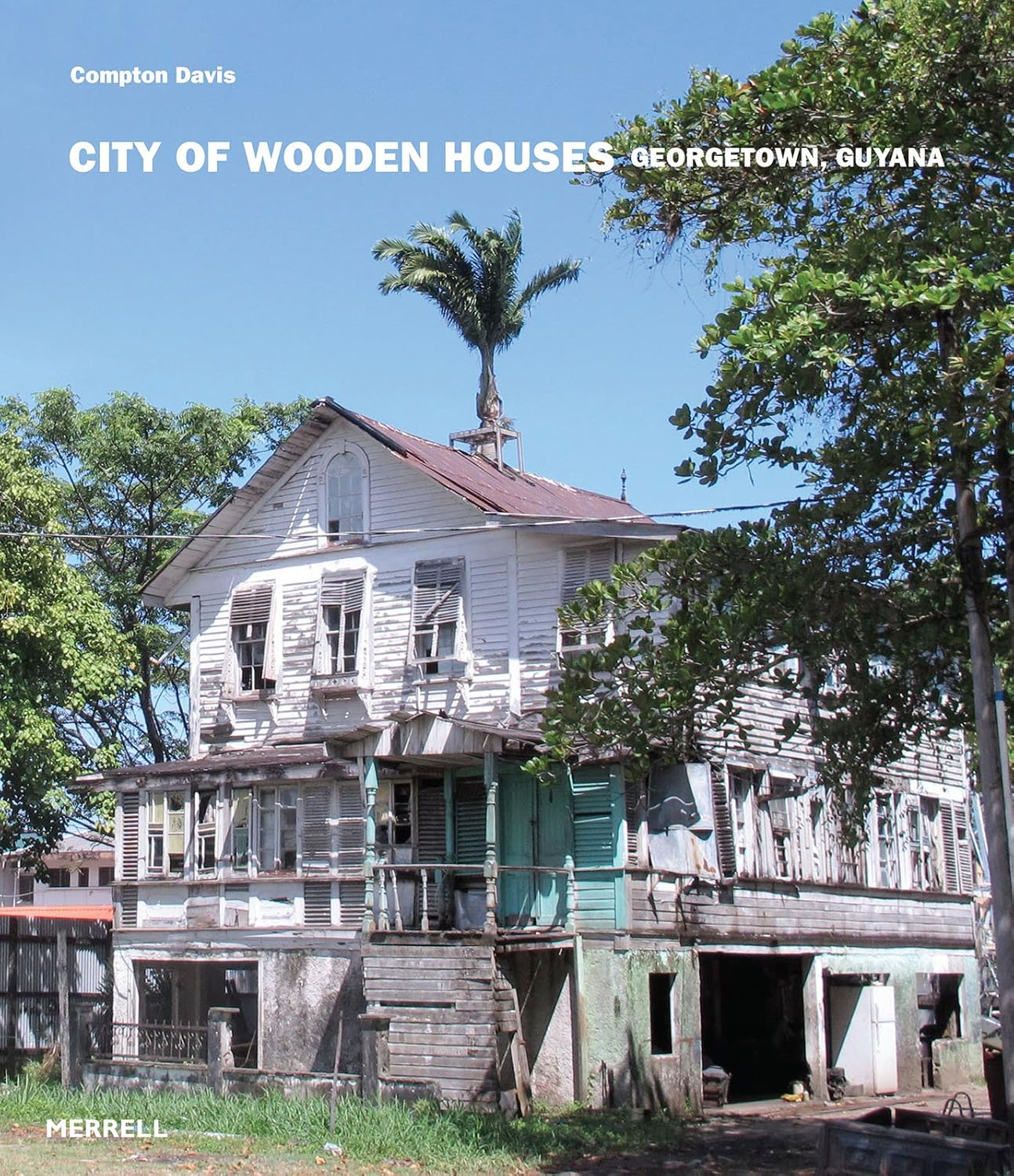
Cover art: Colonial style home in Georgetown in state of disrepair. Courtesy of the author.
Title: City of Wooden Houses Georgetown, Guyana
Published: London and New York 2017 by Merrell
Author: Compton Davis
Editor: N/A
Description: City of Wooden Houses is “a fascinating photographic and historical survey of the colonial wooden architecture of Georgetown, Guyana.” Written by Compton Davis a Guyanese architect who practices in London the book is one of the best and only visual and written descriptions of Guyanese architecture in existence. Davis was in Guyana and moved to England in the 60s to finish his architectural degree at the Polytechnic of Central London (now the University of Westminster).
(City of Wooden Houses, Back Cover)
Themes of City of Wooden Houses
Overall
I think the best summary of this book can be found on the inside jacket of this beautiful book. “Georgetown, the capital of Guyana, on the northeast coast of South America, has been described as ‘the Venice of the West Indies’, and its elegant canals and bridges, lush tropical vegetation and handsome buildings make it a place of great beauty. The city’s architecture is essentially colonial, having been molded by the French, Dutch, British, and Spanish during the eighteenth and nineteenth centuries. Built in a classical style reinterpreted by local craftsmen and realized largely in wood, these buildings are now suffering from neglect and the ravages of the hot, humid climate. Some are being carefully preserved and maintained, but many more are disintegrating or being demolished to make way for new development.
This book documents those colonial buildings, some of which have disappeared even since they were photographed. After giving a brief history of Georgetown itself, describing the influences that resulted in its charming characteristic architecture, and explaining the city’s various house types, Compton Davis divides the centre of old Georgetown into its various districts and describes the notable houses to be found in each. Photographs of the buildings and their particular features are accompanied by short descriptive and historical texts.
This beautiful book, lovingly photographed and researched over several decades, will appeal to architecture lovers everywhere, as well as to those interested in colonial history, the visual history of South America and the history of building in wood. It will also appeal to conservationists and preservationists, and anyone interested in the protection of vulnerable buildings.” On top of the historical framing of Georgetown and its colonial buildings, Davis also alludes to the native structures Benabs built for thousands of years as well as the new modern buildings beginning to emerge in Georgetown. The historical context and three types of buildings make up the major elements of Davis’ text.
Historical Context Surrounding the Wooden House
Former President of Guyana, David A. Granger begins the book with the chronology of colonial possession that sets to stage to understand the formation of the wooden houses of Georgetown. The City of Georgetown was founded 235 years ago. The Spanish were some of the first Europeans in present day Guyana however their focus for colonization laid outside the Guiana Shield. The most famous early example of Colonial Guyanese Architecture is Fort Kyk-Over-Al which was constructed by the Dutch in 1616 and was likely one of the first colonial structures we have evidence of today. The French took control from the British on 2/3/1782. Control was later returned to the Dutch who in 1784 renamed the French center La Nouvelle Ville to Stabroek. Then on the 22nd of April 1796 the British once again resumed control and renamed Stabroek to Stabroek Georgetown. The British then controlled this land until Guyana gained independence in 1966 with only a brief interruption of their from 1802-1803. This colonial legacy combined with the local climate and the highly skilled anonymous craftsmen of the 19th and 20th century are the context that surrounded and built what today makes up an integral part of Georgetown’s architectural fabric.
Benabs and Amerindian Architecture
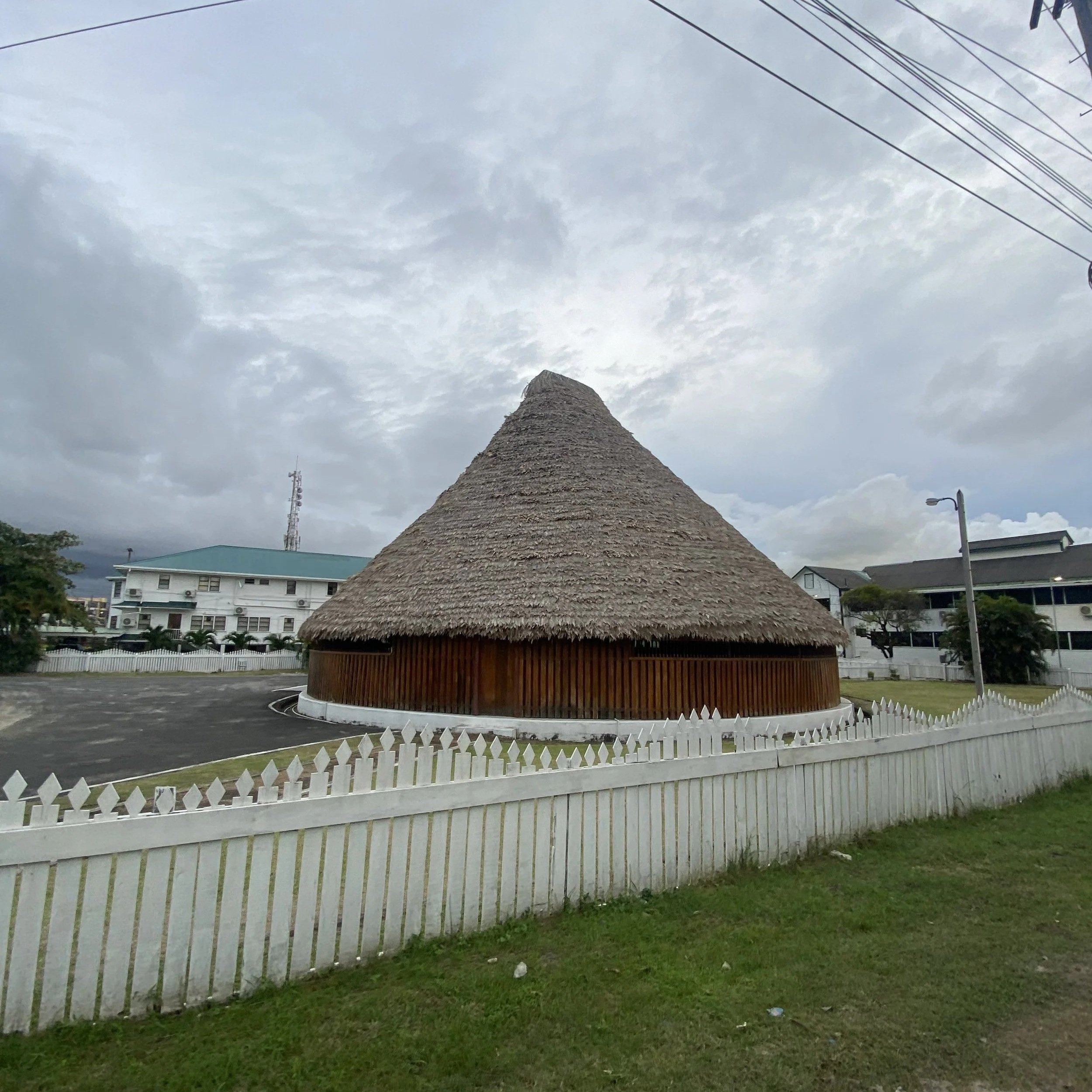
Photo of Umana Yana, a benab and cultural center in Georgetown Guyana taken by Jonathan Plass on May 30th, 2023.
While colonial style architecture is the focus of this book Dr. James Rose, former Director of Guyana’s Department of Culture gives us “…an important reminder that, long before the Dutch constructed the first unembellished and undecorated cottage in the interior lands of Guyana, our Amerindian brothers and sisters had planted their benabs: simple, sparingly adorned, environmentally friendly, providing basic shelter from the elements and a central meeting place for the family." (City of Wooden Houses, 12) While the focus of this text is colonial architecture I think the brief mentioning of these structures in this text alludes to the long term historical impacts of colonization on Guyana where today almost all benabs exist entirely in the interior of the country. While Rory Westmaas and some present day videographers have captured a few benabs it is critical that more research and documentation is done on the structures before their ingenuity is lost to the ravages of time.
Wooden Houses in Georgetown
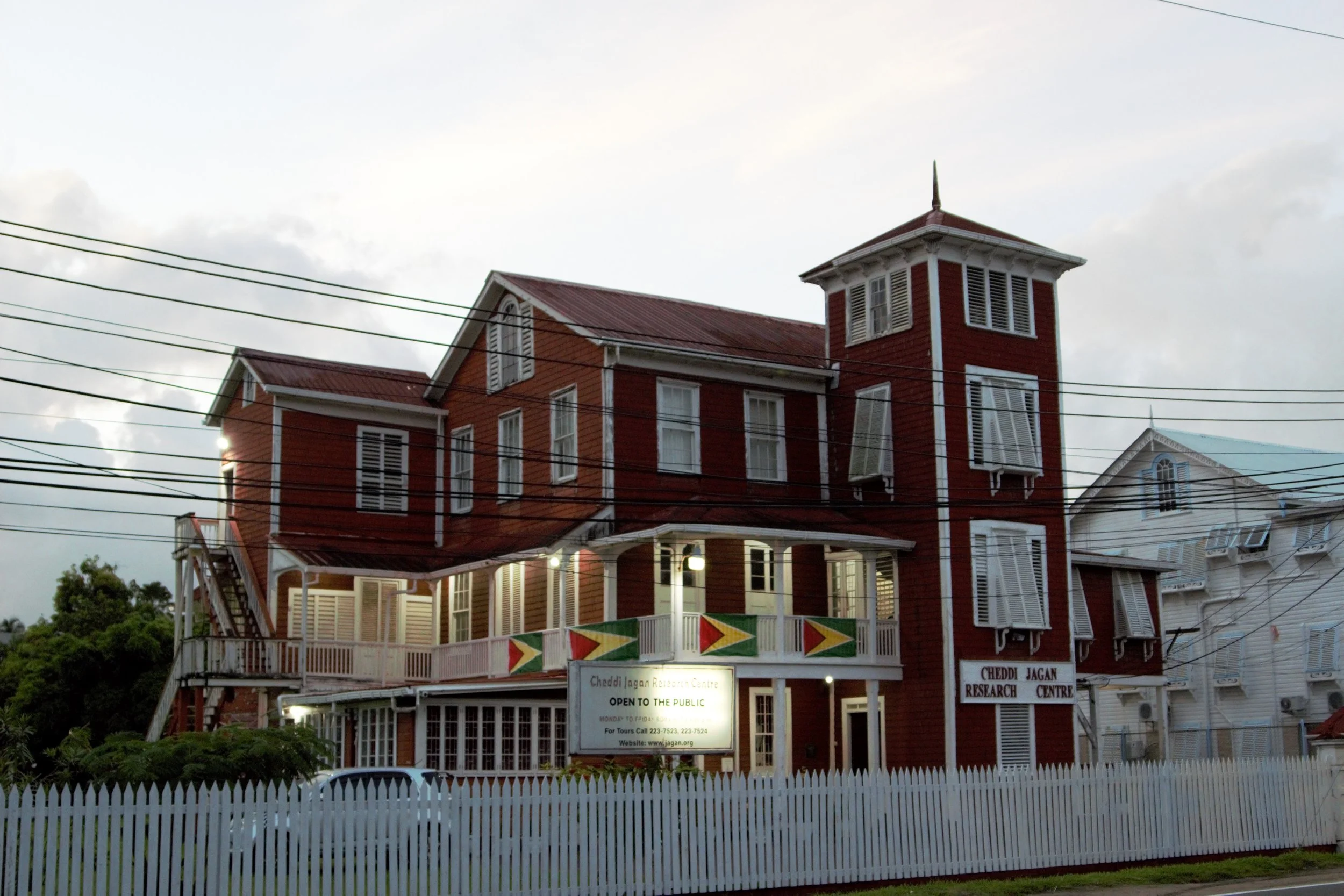
Photo of Cheddi Jagan Research Centre (one of the buildings discussed and photographed by Davis) in Georgetown, Guyana taken by Jonathan Plass on May 30th, 2023.
Broadly speaking the Dutch established the infrastructure and overall plan of the city while the British and French operated at an architectural scale filling in the city grid left by the Dutch. "The influence of the European colonial powers, mainly the British, is immediately apparent in Guyanese architecture and town-planning, and features such as pitched roofs and porticoes with decorated pediments are clearly British colonial in nature. The layout of the city is a legacy of the Dutch engineers who designed it in such a way as to counteract its drainage problems. The decorative aspects of building and detailing evolved from southern European and Asian influences. These facets were brought together by the skilled local craftsmen of Guyana - all anonymous - to create graceful, elegant buildings." (City of Wooden Houses, 180)
Zooming into an architectural scale, one can now perceive the dominating British influence on Georgetown. "At its most basic, Guyanese architecture can be described as colonial in style. The French, Dutch, Spanish, and British all brought with them their respective local vernacular and the classic language and formal style of contemporary eighteenth- and nineteenth-century European architecture, with its emphasis on proportion, rhythm and decoration. These elements were reinterpreted by local craftsmen and constructed in wood. It was the British - the most influential and the final colonists - who, while developing the cities and plantations, brought the distinctive style that they were able to impose in the absence of a local vernacular." (City of Wooden Houses, 16) One of the most iconic elements of this colonial style found in Georgetown is the demerara window which can be seen on the windows to the right side of the Cheddi Jagan Research Centre which is a national monument in Guyana. The Red House was “the former home of Sir Eustace Woolford, Speaker of the House of Assembly…” before becoming “the residence of British colonial secretaries…” before transitioning into its present use as a research institute. One of the most iconic elements of Guyanese Colonial Architecture can be seen clearly on the ‘Red House’, the Demerara window. The Demerara window is a clear example of how local craftsmen’s reinterpretation of colonial architecture was influenced by climate, allowing the building to breathe and get much needed air to circulate through the structures they adorn.
‘The Slow Creep of Modernism’
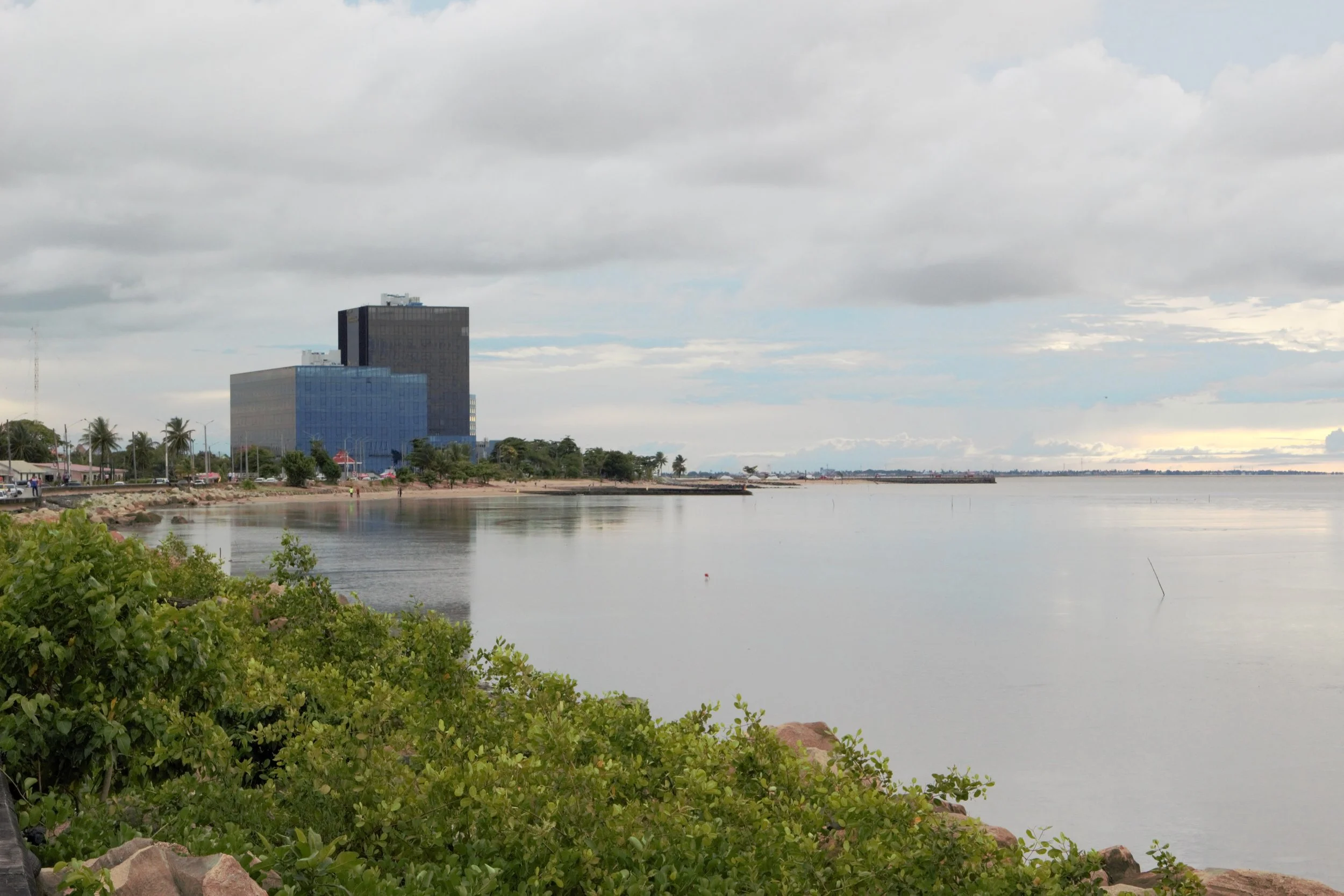
Photo of the coast showing contemporary structures towering over Georgetown, Guyana taken by Jonathan Plass on May 30th, 2023.
"Since the mid-1980s, when the earliest of the photographs in this book were taken, a profound change has occurred. Many colonial houses have been destroyed by fire, decay and, more recently, demolition, and the slow creep of modernism is reflected in the glass-and-concrete buildings - apartment blocks, shopping malls, offices - that are rapidly replacing them." (City of Wooden Houses, 16)
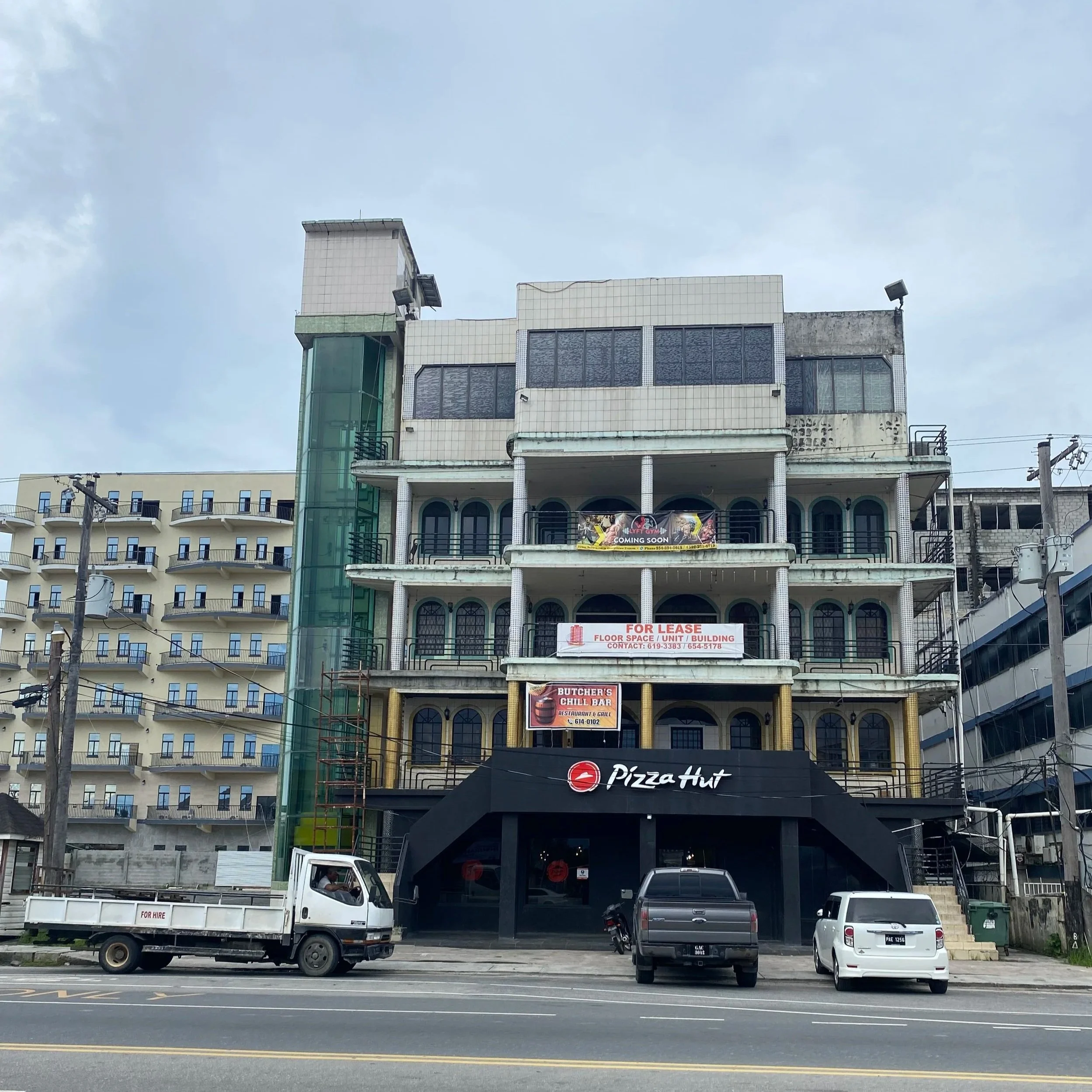
Photo of contemporary structure including a Pizza Hut in Georgetown, Guyana taken by Jonathan Plass on May 30th, 2023.
While this is not to say modernism and contemporary design is bad by any means it is a cautionary tale of what is to come if these designs are not tailored to Guyana’s climate and needs of its people. When colonial architecture was brought to Guyana it was radically adapted to work in the Guyanese weather. We must remember modernism was created in the West by the West and for the West. Even just think about the modern air conditioner that has been ravaging wooden homes in Guyana for decades. It was designed in the West for Western climates not the humid coast of Guyana. Because of this these air conditioners create moister differentials between the interior and exterior of these structures causing boards to split and require repair. And this is not to say Guyana cannot have air conditioners either but it is to say that these air conditioners must be designed by Guyanese for Guyana and be set to keep the right levels of moisture and humidity in the air to keep spaces cool while not causing damage to wooden structures.
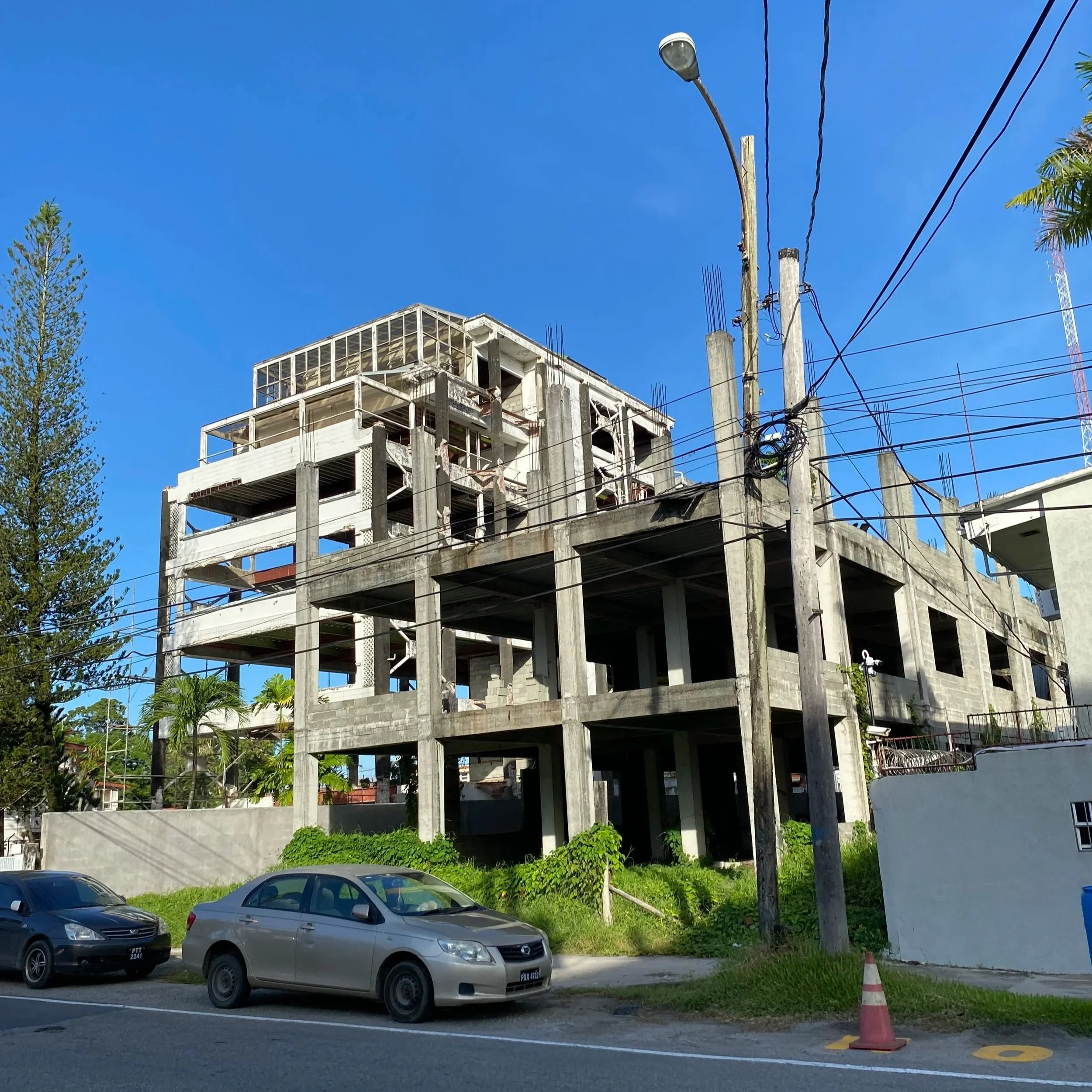
Photo of concrete structure partially completed and seemingly abandoned in place in Georgetown, Guyana taken by Jonathan Place on May 30th, 2023.
"As can be clearly seen in this book, in Georgetown this heritage is being swept away by the inevitable progress of modernization and the economics of conservation. Many of the wooden buildings documented here are almost 150 years old. The most recent additions to the cityscape that correspond to the classic tradition of building are less than 100 years old. A combination of factors, among them the ravages of time, the shortage of appropriate materials and economic conditions, all play their part in the loss of these buildings." (City of Wooden Houses, 180-181) Hopefully in the future the historical buildings of Georgetown will be protected and preserved and the new ones will be thoroughly adapted for Guyana and its people.
Table of Contents:
Foreward
David A. Granger, Former President of Guyana
Foreward
Dr. James Rose, Former Director, Department of Culture, Guyana
Introduction
Georgetown and its Building Tradition
The Wooden Houses of Georgetown
Queenstown
Kingston
Cummingsburg
Stabroek
Robbstown and Bourda
Conclusion