BOTM 007 | Global Guyana
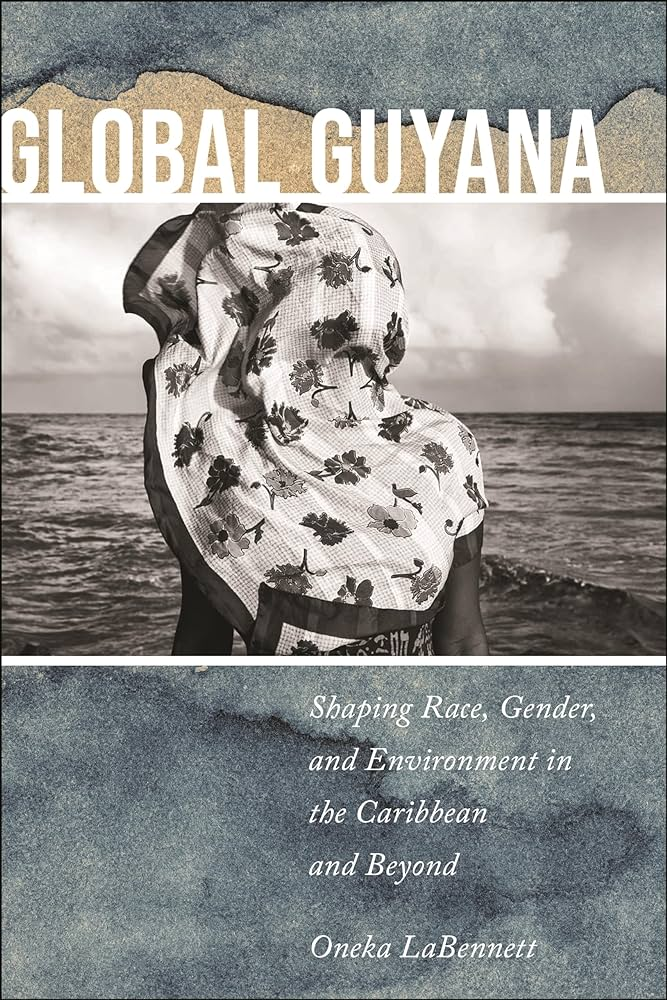
Cover image ‘Within/Between/Corpus by Keisha Scarville. Cover Design by Adam B. Bohannon
Title: Global Guyana: Shaping, Race, Gender, and Environment in the Caribbean and Beyond
Published: New York 2024 by New York University Press
Author: Oneka LaBennett
Editor: N/A
Description: Oneka Labennett’s Global Guyana: Shaping, Race, Gender, and Environment in the Caribbean and Beyond takes ‘a pointer broom approach’ to sweeping into view ‘a political economy of erasure’. “It explores distinct yet interrelated realms, including media representations, women’s kinship ties, and the circulation of people and resources, in order to reimagine this understudied place [Guyana] as a cynosure that exposes the gendered and racialized nodes of global capitalism, while reshaping the geopolitics surrounding extractive industries and the very topography that has come to be emblematic of the Caribbean region-beaches and shorelines.” (Global Guyana, XI) The book covers four main themes; race, gender, sand (‘environment’), and oil (‘beyond’). While focusing on each topic across four chapters LaBennett additionally reveals the global intersections between each topic illuminating the complex global web of Guyana as seen from a Guyanese perspective. Using her own family history, Rhinana and global media, sand, and oil LaBennett paints one of the most vivid contemporary understandings of Guyana and its diaspora.
Preface / A Pointer Broom Approach
Buxton Spice
Oonya Kempadoo
As I swept the floor in the early morning light, the dust would just rise up and float twinkling out the windows. The broom stroked every plank . . . sweep, sweep, sweep, stamp the broom. Sweep, sweep, sweep, stamp, stamp. . . . The sss-weep of the broom going slow, flicking at the end, before the stamp. . . . Now all the dusty creeks joining the main river to flow past the settee and down the steps into the dark depths at the bottom of the front door.
(Global Guyana, VII)
ConVERSations with Nathanial Mackey
Kamau Brathwaite
This is a ole yard, okay? and this old woman is
sweeping, sweeping the sand of her yard away
from her house. Traditional early morning old
woman of Caribbean history, She’s going on
like this every morning, sweeping this sand-of
all things!-away from. . . sand from sand,
seen? . . . And I say Now what’s she doing?
What’s this labour involve with? Why’s
she labouring in this way? all this way?
all this time? Because I get the understandin
(g) that she somehow belives that if she don’t
do this, the household ~ that ‘poverty-stricken’
household of which she’s part-probably head
of ~ would somehow collapse"
(Global Guyana, VII)
The two excerpts above provide a good entry point to describe how LaBennett uses the ‘pointer broom approach’ to sweep into view and intertwine race, gender, sand, and oil. Historically domestic labor such as sweeping with a pointer broom was done by non-whites (race) who were typically women (gender) with the goal of ridding the home of debris (sand) with the hope of a better future (oil). One can quickly see how the hope of this better or cleaner state is almost futile as sand will always find its way back inside the house just as the lingering effects of colonialism never seem to allow nations to fully realize their potential through unity and equitable development. This ‘pointer broom approach’ is central to the text and is what links these, at times disparate, topics together.
From Full Dougla Girl:
“All ah You in Here Is Black People!”
In the first chapter of Global Guyana LaBennett tells the story of how she ‘discovered’ /proved that her primarily Indo-Guyanese family actually was of mixed ancestry. “This chapter recounts how I combed the archives and swept this open family secret into view. This chapter is not about the incompatibility of Afro-Asian identity. Rather, it is about a group of people who mostly identify as Indo-Guyanese, but who have also been Black since the late 1800s.” (Global Guyana, 38-39) Using clues hidden in plain site like the texture of LaBennett’s great grandmother Tily Mackania Jaisingh’s hair and archival records of her family’s journey from India to Guyana. LaBennett uses this family story to touch upon a larger topic at hand that is the taboo of inter racial marriage and how these taboos rooted in colonialism still linger into present day Guyana’s racially divided political system. “‘Dougla’ has its cultural and linguistic origins in India, and Munasinghe writes, ‘In the 5th edition of John Platts’ Dictionary of Urdu, Classical Hindi, and English (1930), Dogla is defined as ‘Not of pure blood or breed, mean-blooded, cross-bred, hybrid, mongrel, double-faced, deceitful’ (534)’” (Global Guyana, 46) But today in Guyana will see something called apan jaat in which each race votes for itself in the case of Guyana Afro-Guyanese tend to vote for the People's National Congress (PNC) and the Indo-Guyanese tend to vote for the People's Progressive Party (PPP). While this is a vast simplification of the topic this divide leads to only one group getting its way for a period of time before the pendulum swings back around. This divide from colonialism that makes it hard for Guyanese to find political unity is not a uniquely Guyanese problem but one faced around the world in post colonial states. “…No side would allow the other to govern Guyana. We always knew this, but we persist with the winner-loser paradigm. In the end, nobody wins an election in Guyana.” (Global Guyana, 168)
Rihanna’s Guyanese Pattacake and the Homewrecking, State in Barbados
To all you Bajan girls out there no disrespect just a little advice from a Guyanese girl
Oh lawdy
Di da die
. . . . I want all yuh Bajan galls, stop all o’ this complaining
How we Guyanese gals thiefing all yuh husband and yuh boyfriend
. . . . Bajan gal stop it right now, stop all de finger pointing
How we Guyanese gals thiefing all yuh husband and all yuh men
Bees does always find honey, and ants does run to sugar
So don’t blame we if all yuh man like de sugar from Guyana
. . . . If yuh wanta keep yuh man, darling, take my good advice
Some o’ yuh Bajan gal mus learn to treat a man nice.
So yuh must learn to wine, like de Guyanese
Learn to grind like de Guyanese
(GT Advice - Madd. Ft. Guyanese Girl)
In the second chapter LaBennett uses “…popular Barbadian calypso sung by an Indo-Guyanese woman, ‘GT Advice’, as a springboard for investigating the tangled gendered racializations that have entwined the two nations.” (Global Guyana, 91) Using this popular song LaBennett is able to unpack the complex histories of Guyana and Barbados jumping from the trope that Guyanese women are homewreckers to amnesty laws like the Barbadian First laws that forced Caribbean nationals to legalize their residency or face deportation. “‘GT Advice’ was released in Barbados in 2009 and became a massive hit after it was performed that year at the Crop Over festival, a historically situated summer festival commemorating enslaved Africans’ celebration and public resistance upon the completion of the sugar cane harvest… The release of ‘GT Advice’ coincided with the introduction of a series of state policies aimed at controlling migration within the region and removing CARICOM nationals from Barbados. The legislation gave the thousands of undocumented CAIRCOM nationals residing in Barbados an ultimatum: turn themselves in to immigration authorities and begin the process of ‘regularizing their immigration status’ or risk deportation.” (Global Guyana, 92-93) LaBennett further reveals how these tropes hurt both Guyanese and Bajan women by pitting them against each other as seen in the previous chapter on race and apan jaat politics. LaBennett further dives into this divide using media representations of Bajan (and Guyanese) super star Rhianna. It is clear how the media portrays her as a Bajan icon almost entirely ignoring her Guyanese heritage as for the global media the white sand beaches of the well known tourist destination Barbados make a much better story than the often overlooked Guyana that many Americans have never heard of outside of Jones Town and oil. Here Rhianna’s embodiment of both cultures is a literal example of how these cultures could co-exist in harmony rather than pitted against each other. In common discourse there is often this tension between the two nations often written online as GT vs BT referring to each nation’s capital city.
Transplanted Beaches and Silica Cities:
Sand Erasure, and Erosion in the Age of the Anthropocene
The third chapter of this book traces the sand the pointer broom desperately tries to remove from the yard to and from Guyana. This chapter reveals how Guyana’s almost entirely beach-less coast is the source of so many of the ever eroding white sand beaches in the Caribbean international tourist enjoy visiting. Rarely acknowledged, as it would undermine each countries authenticity, is the fact that many of these beaches rely on imported sand from Guyana aren’t the slightest but local. But this phenomenon is also not unique to the Caribbean. “From the start of the twenty-first century, Singapore has been the world’s largest importer of sand, and its horizonal expansion has been immense, the city-state having imported a reported 517 million tons of the material to increase its territory by about 24 percent. (Global Guyana, 124) Sand is the world’s second most used resource behind water and is the biggest environmental problem you have likely never heard of. The exportation of all this sand from Guyana has harmed ecosystems and damaged the environment across the country. The demand for this sand has even gotten so intense that “…villagers told us that one night some people came with trucks, armed with guns, and they stole their beach away.” (Global Guyana, 125) This exportation of sand for profit to fuel development is compared to Livingston’s depictions of Botswana’s ‘self-devouring growth’. Because this industry is relatively new in Guyana we are not yet sure what the full ramifications of sand exportation will be but it does seem evident that if not controlled and executed thoughtfully, Guyana’s sand may be lost for ever eroding the incredibly diverse ecosystems across the country.
Recasting El Dorado:
Representing Oil, Politics, and Ethnic Conflict
The final of the four chapters discusses the future of Guyana as a petro-state and how the profits from the newfound oil may be used for development of the nation. LaBennett does this cleverly by linking the oil of today to the gold of the age of explorers. The tale of Guyanese oil is the same tale of the exploitation of Guyana by European explorers searching for gold in which value is extracted from Guyana for foreigners giving next to nothing back to the people of Guyana. This chapter discusses the unfavorable oil deal Guyana signed and how ExxonMobil is currently extracting billions of dollars worth of economic value from Guyana and sharing next to none of it with those who’s oil they are pumping. This chapter also centers around the global medias coverage of the idea of the resource curse and how Guyana will inevitably mismanage its newfound wealth and remain poor and politically divided. While this may be true these stories never mention that those problems stem for the three previous chapters and the scars of colonialism left long before on the land of Guyana by European colonizers. At fails to promote ways around these issues and hold foreign investors accountable for preying on a nation with very few options of defending itself. All in all, Global Guyana is a fascinating intersectional look through time about how race, gender, sand, and oil are intertwined in Guyana’s local and global representations.
Table of Contents:
Preface:
A Pointer Broom Approach
Introduction:
Everywhere and Nowhere: A Sweeping Vision of/from Guyana
From Full Dougla Girl:
“All ah You in Here Is Black People!”Rihanna’s Guyanese Pattacake and the Homewrecking, State in Barbados
Transplanted Beaches and Silica Cities:
Sand Erasure, and Erosion in the Age of the AnthropoceneRecasting El Dorado:
Representing Oil, Politics, and Ethnic Conflict
Coda:
The Road Ahead