BOTM 009 | ConVERSations

Cover by Brathwaite in his now distinct and characteristic "Sycorax 'video style'" format.
Title: ConVERSations with Nathaniel Mackey
Published: Staten Island, NY, 1999 by We Press
Authors: Kamau Brathwaite, Nathaniel Mackey, Chris Funkhouser
Editor: N/A
Transcription: Chris Funkhouser
Description: ConVERSations is an avante-garde mix of conversations and poetic verses. "Kamau Brathwaite's conVERSations with Nathaniel Mackey is based on the transcript of his 1993 public discussion with Nathaniel Mackey at Poet's House in New York City. Brathwaite expansively elaborates on Mackey's (and audience's) knowledgeable inquiries; his answers are layered with subsequent ruminations arising from his lifelong engagement with world literature and expressive cultures. A multiphasic drift, conVERsations with Nathaniel Mackey combines elements of biography and autobiography with poetic discourse on Caribbean literary history and negative effects of colonial domination. Brathwaite splices dialog with poetry, criticism, and instructive imaginary voices in his now distinct and characteristic "Sycorax 'video style'" format." (conVERSations, Back Cover) Scattered in nature and structure the conversation and verse’s form mirrors the inconsistent and fractured timeline common of diasporic histories.
Sycorax 'video style'" format



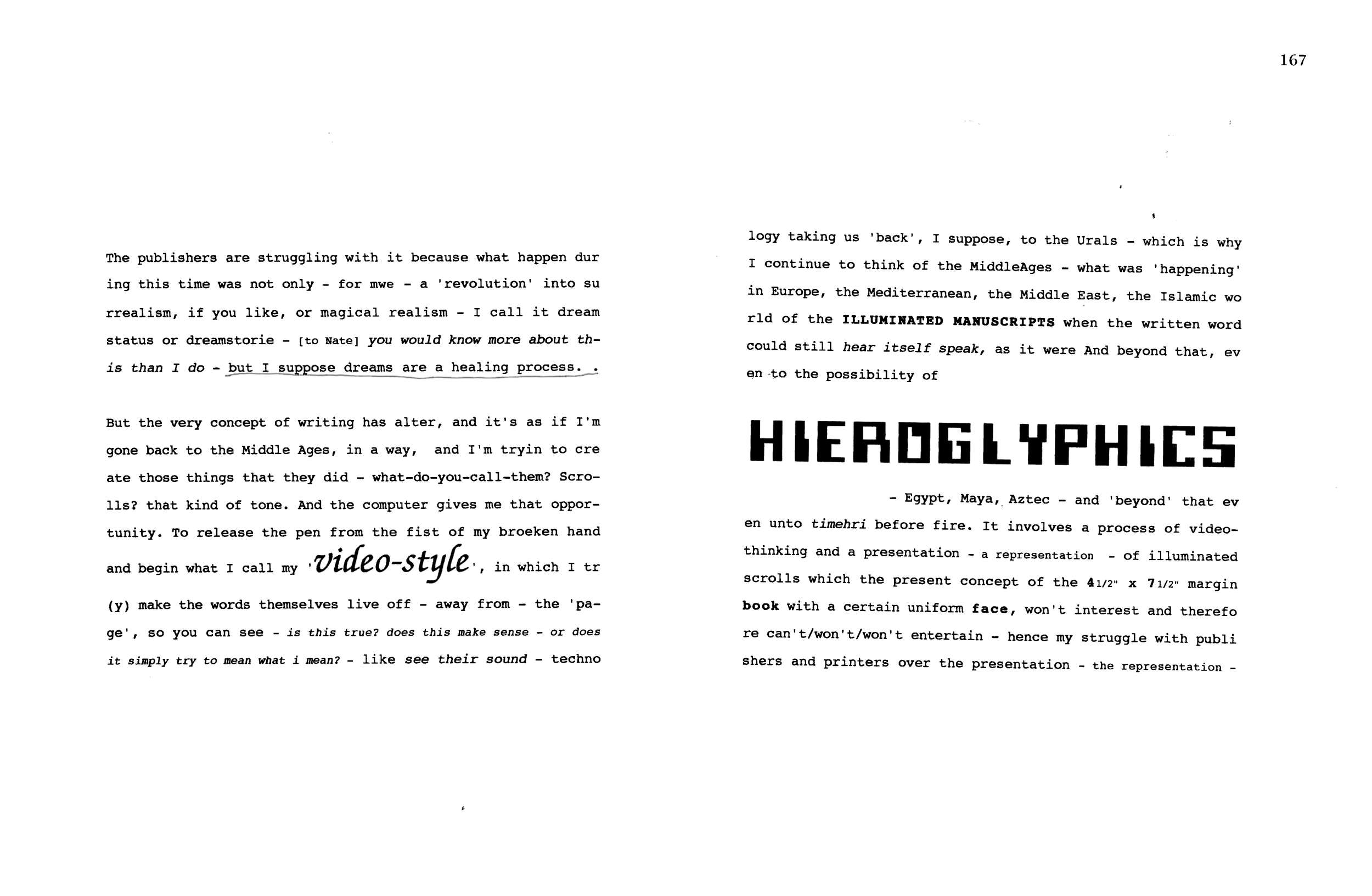
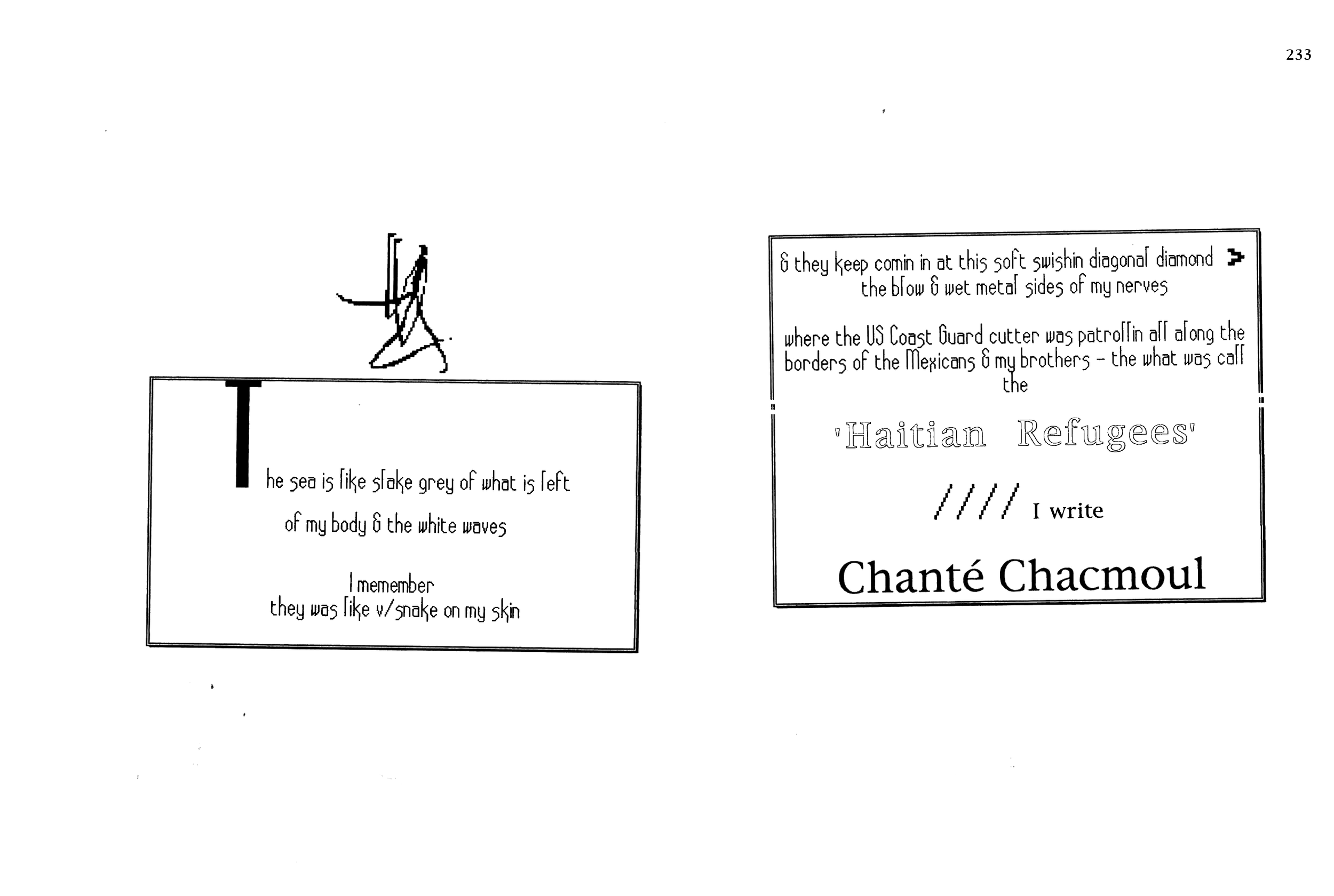
One of the most interesting parts of conVERSations is its typographic visual work known as "Sycorax 'video style'" format." (conVERSations, Back Cover) The typography used to typeset the books content, just as its content does, mirrors the inconsistent and fractured timeline common of diasporic histories. Some stories are big and bold and easily rembered and others are small almost blurry fragments that at times are hard to read.
The Question of Audience & Memory
One common question for everyone from artists to business owners to everyday people is the question of audience. Who are you/we presenting to? Is it an art collector, a friend, an institution, or yourself? The question of audience seems to augment the work almost as much as the concept behind the work itself. "[Audience: ?sympathetic shimmer. At another time we shd perhaps discuss the Q of AUDIENCE: (a) communication w/; (b) ?responsibility for: i mean does the poet/artist seek an audience & if so, how? or does the 'audience' seek/find the po/artist & is this a factor/feature of 'market forces', publicity, 'message' ('relevance'), fashion/flashion &/or what mixture of these? etc etc etc]" (conVERSations, 25-26) Should the a “true” artist seek an audience? If one doesn’t seek an audience and their work is never seen does it make a (visual) sound? The debate of art for arts sake and art for an audience will never end, they will be perpetually in struggle and at their best may find an equilibrium but never an all out victor.
Another critical theme in conVERSations is memory. Memory is this ever elusive idea that we all inherently understand at a surface level but even modern neuroscience is still learning lots about how the brain creates, stores, and recalls memories. One of the most common topics of memory in diasporic dialogues is place. "But i know he miss his house the beach his heart the memory his home"(conVERSations, 89) The act of migration leaves many with only a mental memory of their former home. "this photograph is taken at a mansion house - 'trafalgar' marhill street my mother say she born me in. a place i didn't know a time i can't remember how cd they make a memory of time i cant remember how cd i have been there & yet forget"(conVERSations, 98) Where is the memory we can’t recall stored? Is it truly gone or have just not the right triggers been activated to make it jump into the front of our minds. Is forgetting true erasure of memory or simply a failure to recall said event. Regardless memory is murky and manifest in many ways in diasporic contexts. Memory can also be seen by fleeting relationships of those now physically distant "but as i say, i never get to know him to even le(t) him know i love him love him love him love him"(conVERSations, 89)
Development
Another theme within conVERSations is development of colonized places. At an overall level, "...it seems to me - more and more - as being permanently not only underdevelop (result of history etc) but underdeveloping. . . and warse - perpetually mendicant. I mean, is one thing to be poor - the 'culture of poverty' etc has its place in the concept of maronage*, Buddhism*, Hinduism, early Christianity, some branches of monasticism etc etc"(conVERSations, 105) Here we can see how memory, history and the spotted nature of both in these contexts leads to this underdevelopment that is by colonial design. It is asked, almost rhetorically, "...Why is my beuatiful landscape harbour so materialistically rather than so magicalistically exploited?"(conVERSations, 104) which is followed shortly thereafter by the answer. "'Hotels are squatting on my metaphors'"(conVERSations, 105) which is most certainly a reference to the extractive business models of the global tourism industry. While much of the discussion surrounding development is bleak, there is one positive possibility posited in which there is independence. "[to the audienc(e)] Do I hear you say 'that same own dream-on 'utopian'? community where we would grow our own food and in the large rambling house we build there..." (conVERSations, 124) While this might not be the case in every diasporic context Guyana was just ranked the most self-sufficient food system in the world after the government set that goal to feed the nation in the 70s.
Politics, Power, & Self-Definition
There are three more themes found within conVERSations, politics, power, and self-definition. Regarding politics there are constant references to political and academic institutions and the stories surrounding them one of which being the death of Walter Rodney. "After a few yrs in xile, Rodney returns to homeland Guyana, soon to be assassinated (1980) by, it is widely held, Govt agents." (conVERSations, 108) Another theme is power and while from most of the book dismantling the power structure might seem like the obvious solution to problems created by this power we are warned about how often times destroying the unjust system results in its replacement with an equally unjust system. "In other words, as soon as the center of power begins to disintegrate, it does not follow, as we have since seen in the former Soviet Union's empire, that ancillary freedom follows syracuse is a white rumble of desolation the train drifts slowly here slowly like the last lava of a volcano [ibid] What often happens is that a new forum of feudalism, a new form of barbarity comes into the world so that the process towards what the poem calls 'equilibrium', has to be started all over again, and is often subverted altogether - tho not necessarily permanently. And unless these powers, these in this case two primal nodes, these two mountains - can come into some conversation with each othe(r); into some relationship of 'true' balance and equilibrium - we are in/to some kind of new psychic apocalyptic abyss" (conVERSations, 118-119) Here we see not a desire for complete destruction and replacement but rather an balancing of the scales. Something that may be possible through more inter-party collaboration and compromise rather than the new ruler takes all model. Lastly there is the theme of self-definition which may be one part of the solution to how these scales are balanced. "...as if I needed to redefine - having discovered parents (11) - that I have to redefine myself - redefine or rather like marakate mysel(f) much more than perhaps i have before And I begin to ask myself things like what is the nature of my educatio(n)? What is the nature of all these cultural and assumptional continental drifts that make me what I complex fragmented contradictory etc etc etc..."(conVERSations, 104) Not only would creating one’s own history and re-definition of self begin to clear some of these complex and fragmented contradictions but it would also begin to balance the scales of power in which history ignored the small man/woman and only recorded the winner’s narrative.
Table of Contents:
I
II
III
IV
V
VI
VII
VIII
IX
X
XI
XII
XIII
XIV