Title: Haiku
Published: Great Britain 2015
Authors: Stanley Greaves
Editor: N/A
Transcription: N/A
Description: A collection of 140 haiku’s written and illustrated by Guyanese author and artist Stanley Greaves. "Gardens, household objects, frogs, dogs, birds, kites and a host of other flora, fauna, rocks and stones find their place in the fertile mind of a poet, painter, sculptor and musician who has his head in the air but feet on the ground. Sometimes the poems offer perceptions that have never been seen so clearly before, sometimes they hint at elusive, just-out-of-reach. Always, though, 'possibilities beckon', and the little poems, haiku of an individual, invented kind, are metaphysical both philosophically and in the way the metaphysical poets yoked the seemingly disparate into surprising sense. There is an acute awareness of light and shade, textures, the touchable and the surrounding world of sound. As in Greaves' paintings, shifts in perspective and proportion disrupt the habitual view. The gaze looks inward as much as out - at the processes of thought, memory and imagination. The pleasures are both singular and collective: in the polished economy of phrase, form and the moments of surprise, and in the accumulating sense of entering a world that it is a privilege to share. Not least of the pleasures are the eight pieces of original artwork - ink, brush and pen drawings and collages - that offer an alternative vision to the poems." (Haiku, Back Cover)
Greaves’ Haikus
While traditionally Japanese haikus follow a strict syllable format, traditionally focused on describing nature, Greaves’ creates his own Guyanese remix of the format to express many aspects of Guyana and its culture. "I did not, however, attempt the Haiku form of a strict number of syllables in each line, five, seven, five, believing that this has a formal relationship to the Japanese language not perhaps achievable or even necessary in English." (Haiku, Preface) On top of this slight departure from the classic form, Greave also gives the reader insight into how he constructs the poem, something not many authors give readers a glimpse of. "Usually a perception creates a line or two and the rest follows in a single sitting to be edited much later... In the main, however, I preferred the form where the first two lines established a perception with the third creating a philosophical/metaphysical resolution of some kind." (Haiku, Preface) This idea is evident in the selected poems below. Adding one last unique layer to this book of haikus is Greaves’ inclusion of art to accompany certain haikus. "An additional reward for me was the accompanying visual imagery that prompted the pen and ink drawings attending the poems in this edited collection." (Haiku, Preface) Together these Haikus represent a set of poetry and art that is unique and a wonderful addition to the Guyanese cannon.
Rain
#17
Soulless rain claims land,
sorrow comes flooding.
Thoughts hide in dry places.
(Haiku, 16)
If you have every lived of even visit Guyana this will be one of the most familiar haikus Greaves includes describing the all to common tropical weather patterns and our response to them. Guyana is a land often plagued with the problems of flooding both daily ‘floods’ and the more catastrophic floods like the Great Flood of 2005. This topic is also further discussed in the previous BOTM Engineering Vulnerability by Sarah E. Vaughn. But returning to the daily flood those who have encountered tropical rain know all to well to run for the nearest cover to allow the rain pass. In these moments of collective shelter many spark up conversations with strangers or let their thoughts run free waiting for the rain to pass.
Memory
#20
Furniture and pictures whisper,
shadows sleep in the dark.
Old house has memories.
(Haiku, 17)
Here Greaves does an excellent job of evoking the sentiment that memories are also stored in objects and structures. Some of these structures that store these Guyanese memories can be found in the previous BOTM City of Wooden Houses by Compton Davis.
Vision
Stanley Greaves, #22, Ink and Paper
#22
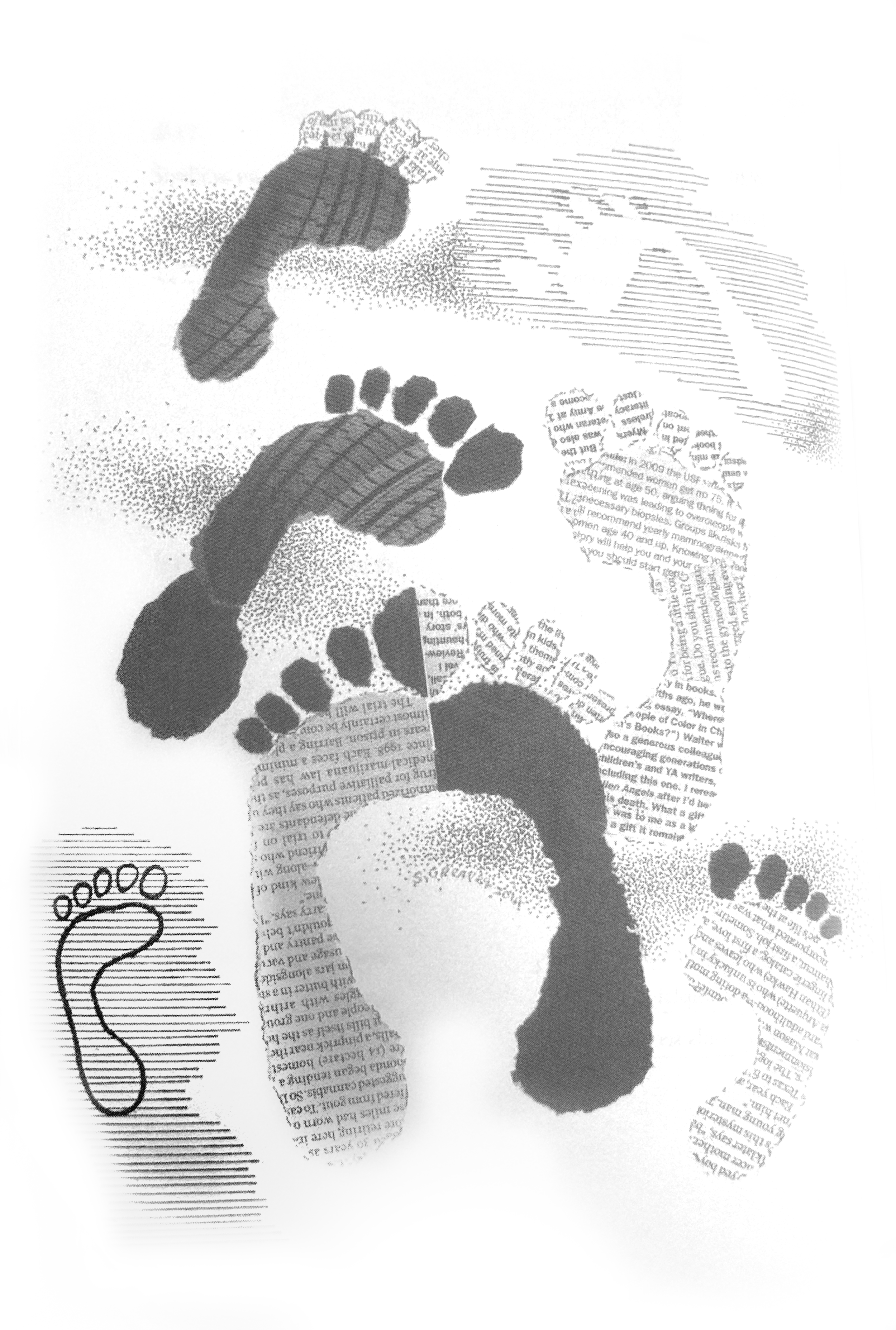
Footprints on ancient trails,
hills uncomplaining.
Errant souls seek visions.
(Haiku, 17)
Identity
#30
Faces in the clouds
so easy to see.
In my mirror a mystery.
(Haiku, 21)
As French writer Édouard Glissant makes so clear in his writing about the Caribbean from the perspective of Martinique, one of the greatest questions facing us is the question of self and identity. Western history and colonialism has made is very easy to study and understand the identity of their nations and leaders, however those of the Caribbean including Guyana are left with much sparser archives and a legacy of slavery and indentured servitude that often leave us cut of from our entire history. One of our great and on going challenges will be to continue in the Sankofic tradition of fetching what is at risk of being left behind so that we have a clearer picture of ourselves.
Class
#35
Upstairs, expensive suits,
air-conditioned meetings.
Ants cross hot black streets.
(Haiku, 23)
Dreams
Stanley Greaves, #71, Ink and Paper
#71
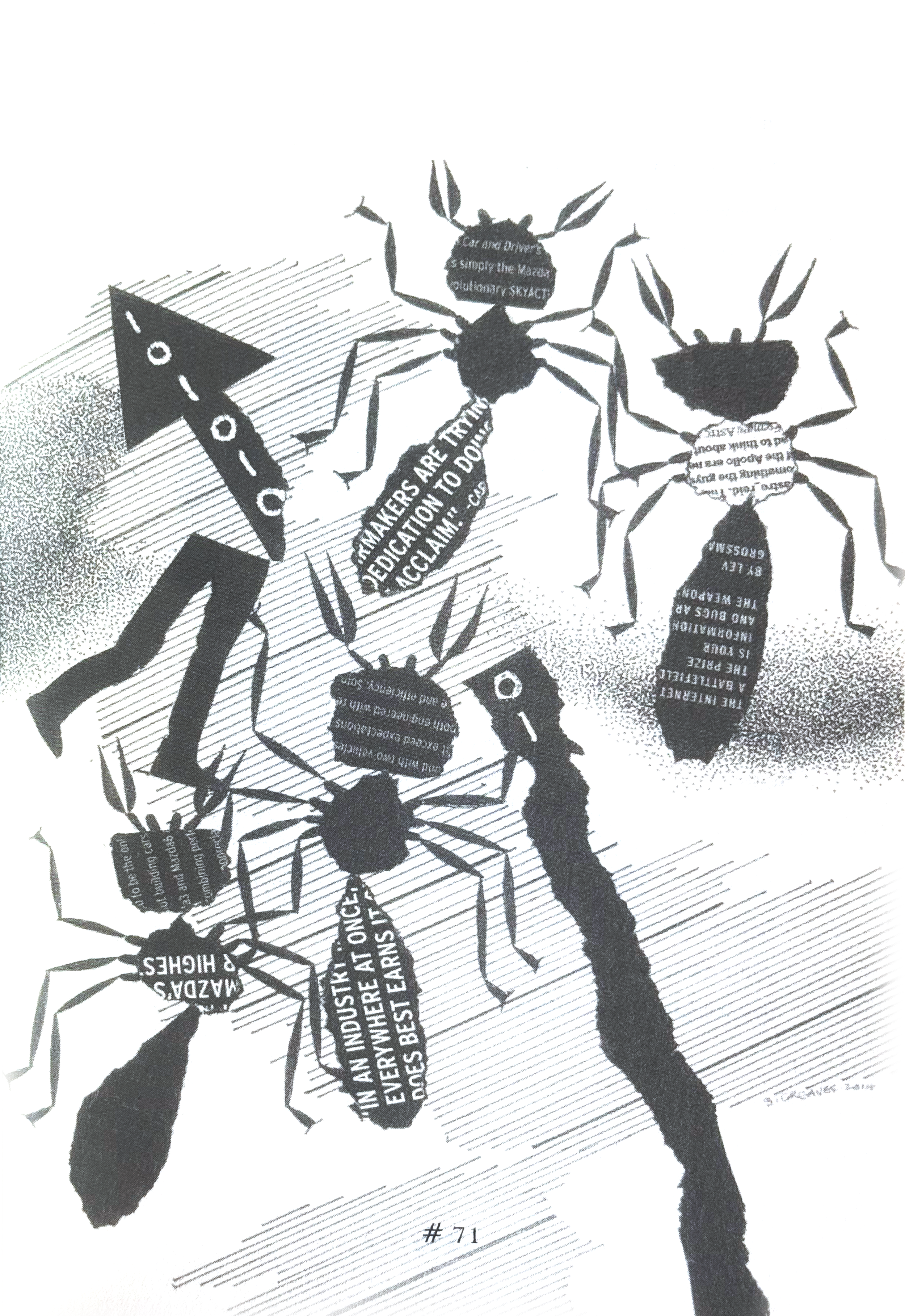
Dream days arrive
thoughts darting everywhere.
Memories of army ants.
(Haiku, 36)
Poets
#121
Pen and paper as bait.
Will the poem bite?
Poet as fisherman.
(Haiku, 55)
Table of Contents:
PREFACE
POEMS